
The Ultimate Website Design and Development Guide: Best SEO & AI Practices for 2026
Search split into five paths at once. Here’s how one website gets found on all of them.
Quick answer:
In 2026, effective Website design and development means building a site that is fast, mobile-first, and easy to navigate for people (UX/SXO), structured so search engines can rank it (SEO), written so featured snippets and voice assistants can extract direct answers (AEO), and organized with clear facts, schema, and authority signals so AI tools like ChatGPT, Gemini, and Google AI Overviews can cite it (GEO/AIO). A modern website has to satisfy all four audiences, a human visitor, a search crawler, a voice assistant, and a large language model, from the same page.
Your website is still the first impression most customers form of your business. But how that impression gets made has changed. A growing share of buyers never land on your homepage at all, they ask ChatGPT, Perplexity, or Google’s AI Overview a question, and your business either gets mentioned or it doesn’t. Designing and developing a website today means designing for that moment, not just for a click.
This guide breaks down what’s actually changed since the old “SEO-only” playbook, and what a website needs in 2026 to be found, understood, and recommended, by both people and AI.
Why Website Design and Development Looks Different in 2026
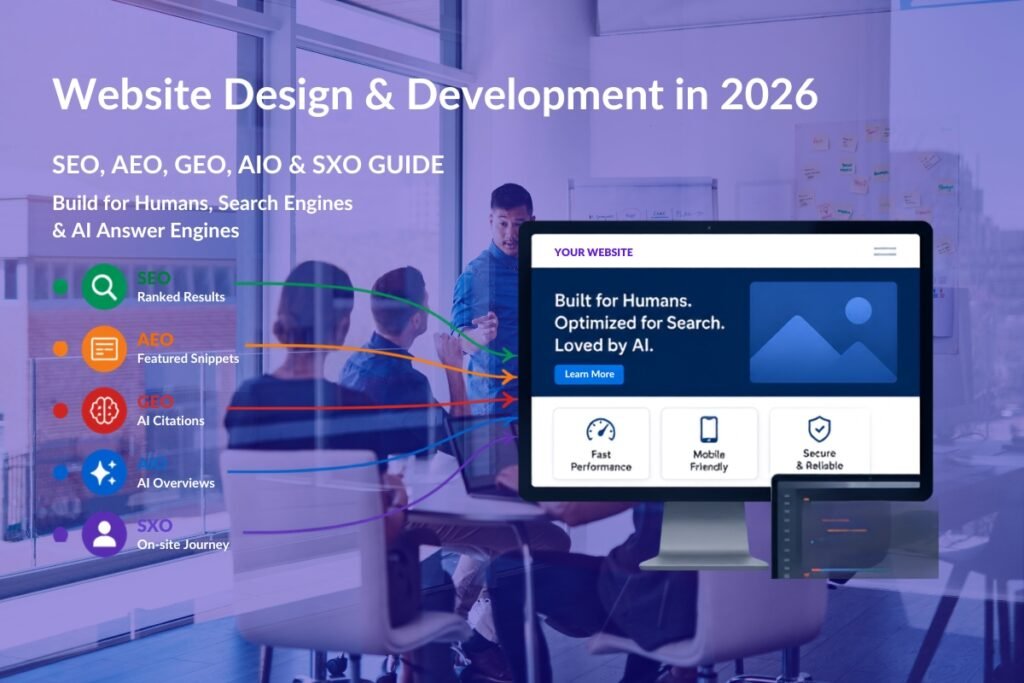
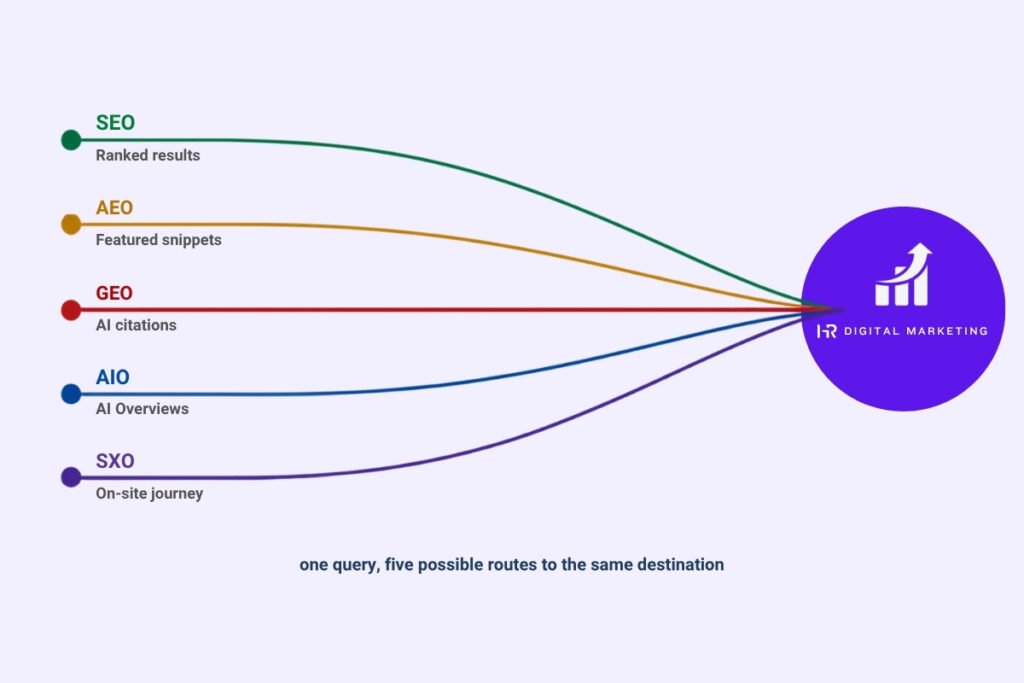
Search itself has fragmented. Instead of one funnel, search engine to website, there are now several parallel paths:
- Traditional search (SEO): Google, Bing, ranked blue links.
- AI Overviews (AIO): Google’s AI-generated summary box at the top of results.
- Answer engines (AEO): featured snippets, People Also Ask, voice assistants, zero-click answers.
- Generative engines (GEO): ChatGPT, Perplexity, Gemini, Claude, tools that read the web and cite sources inside a conversational answer.
- Search experience (SXO): the actual on-site journey once someone does click through.
The reassuring part: these disciplines don’t pull in different directions. Analysts researching 2026 search behavior consistently find the same underlying signals, clear structure, factual accuracy, and demonstrated authority, drive visibility across SEO, AEO, and GEO simultaneously. Design a site well once, for all four, rather than building five separate “optimization” layers on top of each other.
SEO: The Foundation Everything Else Sits On
SEO hasn’t gone away, it’s still the base layer every website design and development project is built on. Multiple 2026 industry analyses point to the same finding: the large majority of AI Overview citations still pull from pages already ranking in the top 10 organic results. If your site isn’t structured well enough to rank traditionally, it’s very unlikely to get picked up by AI answer engines either.
Core technical and on-page SEO fundamentals for website development in 2026:
- Clean, semantic HTML – proper heading hierarchy (H1 → H2 → H3), not styled text pretending to be a heading.
- Fast Core Web Vitals, page load, interactivity, and layout stability still directly affect rankings.
- Mobile-first build, the majority of web traffic is mobile, so the mobile layout is the primary design, not an afterthought.
- Crawlable architecture, flat URL structures, internal linking, and an up-to-date XML sitemap.
- Keyword-aligned content, written around what your customers actually type or ask, not internal jargon.
AEO: Designing Pages That Are the Answer
In modern website design and development, Answer Engine Optimization is about structuring content so it can be lifted out and served directly, in a featured snippet, a voice assistant reply, or a “People Also Ask” box. The design principle is simple: answer first, explain second.
Practical AEO patterns to build into every page:
- Put a 1–2 sentence direct answer immediately under each heading, before the supporting detail, not after it.
- Use the exact phrasing your customers search for as your H2/H3 text, if people ask “how much does website development cost,” that should be a heading, verbatim.
- Write in self-contained blocks. Structure the first 40–60 words under any heading as a complete, standalone answer, since AI systems extract specific passages to build their answers rather than reading a whole page.
- Add an FAQ section with real customer questions and short, direct answers, ideal for both voice search and AI extraction.
- Keep paragraphs short. Three to four sentences, not walls of text.
GEO: Getting Cited Inside AI-Generated Answers
For website design and development teams, Generative Engine Optimization is the newest layer to plan for, and the one most businesses are still catching up on. It’s about making sure that when someone asks ChatGPT, Gemini, Claude, or Perplexity a question relevant to your industry, your business is one of the sources the AI pulls from and names.
What actually moves the needle here, per current 2026 guidance:
- Original data and proprietary insight. Because AI can generate generic explanatory text easily, unique research, case studies, and first-hand data are what earn a citation.
- E-E-A-T signals, made explicit. Author bios, credentials, company history, and verifiable contact information all help an AI model treat your content as a safe, citable source.
- Structured data (schema markup). Article schema for blog posts, FAQ schema for Q&A content, and Organization schema for your business entity.
- Consistency across the web. AI models cross-reference multiple sources before citing one confidently.
AIO: Winning a Spot in Google's AI Overviews Specifically
AIO refers specifically to Google’s AI Overview box, the AI-generated summary that now appears above traditional results for a meaningful share of searches. It’s a subset of AEO, but worth calling out on its own because it runs on Google’s specific ranking signals, not a generic LLM’s training data. Getting this right is now a standard part of website design and development, not an extra step.
To be eligible for an AI Overview citation, a page generally needs to:
- Already rank competitively in organic results, this is non-negotiable.
- Answer a specific query completely and clearly, without requiring the reader to click through for the actual answer.
- Carry credible schema markup and clean metadata so Google’s systems can parse the page’s structure accurately.
SXO: What Happens After Someone Clicks
The final layer of website design and development is SXO, it ties everything togethe: once a person does land on your site from Google, an AI Overview link, or a chatbot’s citation does the actual experience convert them? SXO blends SEO with UX and conversion design:
- Fast, frictionless navigation a visitor should reach what they came for in one or two clicks.
- Clear, singular calls-to-action, one obvious next step per page.
- Trust signals visible above the fold, reviews, client logos, certifications, real contact details.
- Content that matches search intent exactly, if the click came from an answer about “cost,” the landing page should talk about cost immediately.
A Practical Checklist for Your Next Website Design and Development Project
| Layer | What to build in |
|---|---|
| SEO | Clean code, fast load times, mobile-first layout, keyword-mapped pages |
| AEO | Direct-answer openings, FAQ schema, question-phrased headings |
| GEO | Original data/insight, author credentials, consistent brand facts site-wide |
| AIO | Organic ranking strength + accurate schema + fully self-contained answers |
| SXO | Clear CTAs, fast paths to conversion, trust signals, intent-matched landing pages |
How HR Digital Marketing Services Can Help
We build Website Design and Development the way search actually works now, not the way it worked five years ago. That means every site we design and develop is planned around all five layers above from day one: solid SEO architecture, AEO-ready content structure, GEO-friendly authority signals, AIO-eligible technical foundations, and an SXO-driven user journey that turns visits into leads.
Whether you need a new site built from scratch or an existing one restructured to compete in AI search, our team handles the strategy, design, development, and ongoing optimization together, so your site is found by search engines, quoted by AI assistants, and built to convert once someone arrives.
How HR Digital Marketing Services Can Help
Every website design and development project we take on is planned around all five layers actually works now, not the way it worked five years ago, solid SEO architecture, AEO-ready structure, GEO-friendly authority signals, AIO-eligible technical foundations, and an SXO-driven journey that turns visits into leads.
Ready for website design and development that performs across every search surface in 2026?
Whether you need a new site built from scratch or an existing one restructured to compete in AI search, our team handles the strategy, design, development, and ongoing optimization together, so your site is found by search engines, quoted by AI assistants, and built to convert once someone arrives.
Frequently Asked Questions
SEO optimizes a page to rank in traditional search results. AEO optimizes content to be extracted as a direct answer, in featured snippets, voice search, or AI Overviews. GEO optimizes for being cited by name inside conversational AI tools like ChatGPT and Perplexity. They overlap heavily but target different discovery surfaces
Yes. Most AI Overview and GEO citations still come from pages that already rank well organically, so traditional SEO remains the foundation everything else builds on.
AIO stands for AI Overviews, Google's specific AI-generated summary feature. It's a narrower, Google-specific subset of the broader AEO discipline.
SXO (Search Experience Optimization) is the combination of SEO and UX design, making sure that once a visitor clicks through from a search result or AI citation, the actual on-site experience is fast, clear, and built to convert them.
Focus on original data or insight, clear author and business credentials, consistent facts about your business across the web, and structured data (schema markup) that helps AI systems parse your content accurately.
Short answer covering SEO/UX/AI-readiness. This alone adds keyword + naturally answers a real search query (good for AEO too)